
An international training program on Asian and revision rhinoplasty
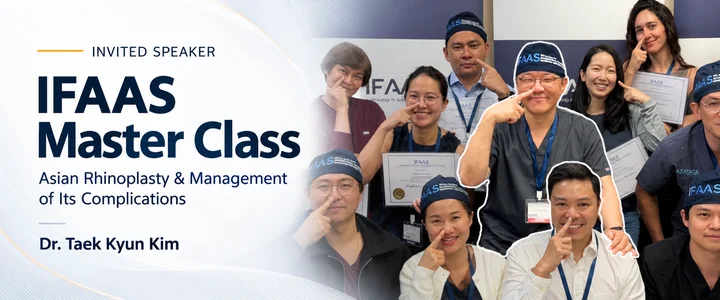
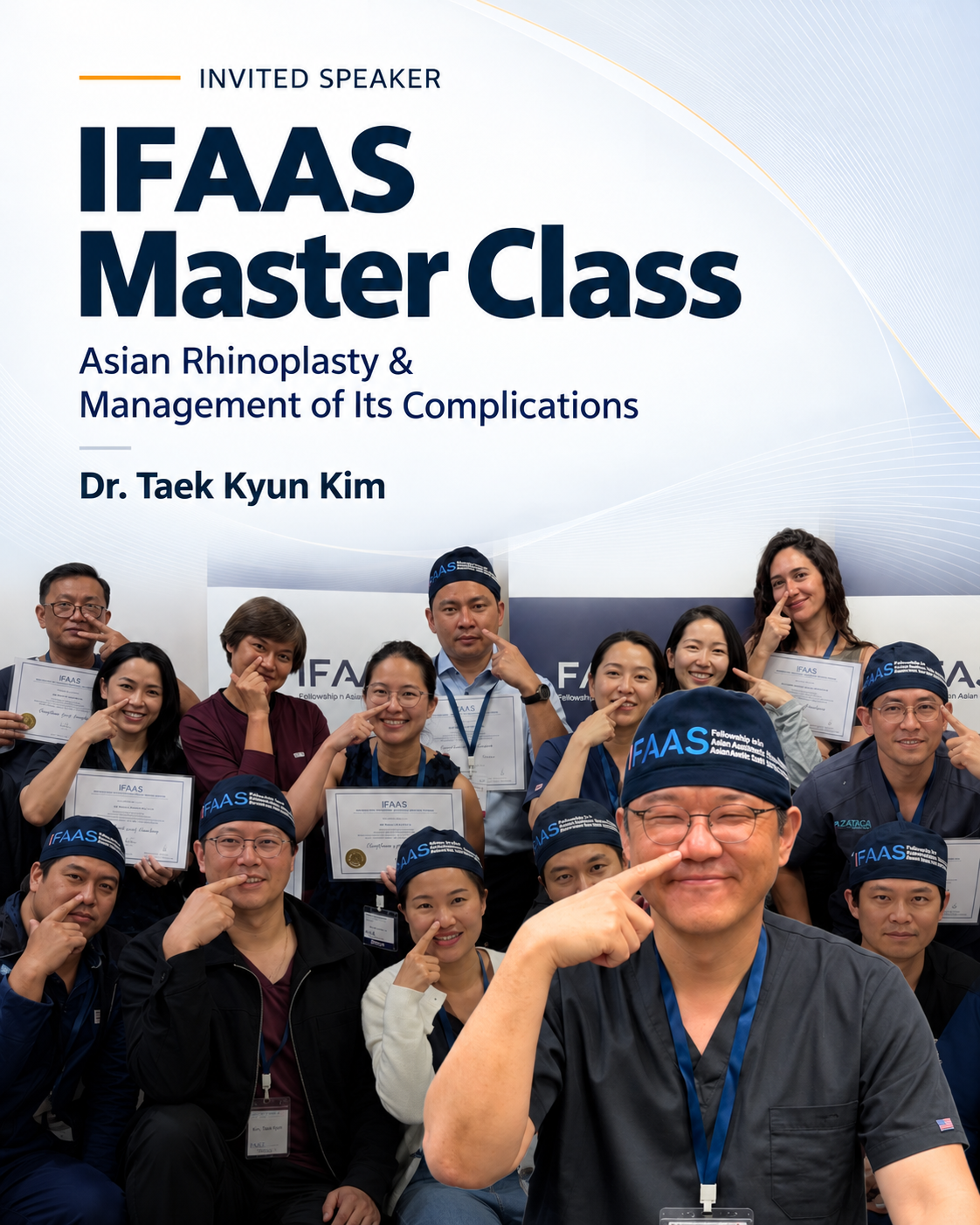
Dr. Taek Kyun Kim of THE PLUS Plastic Surgery served as an official faculty member for the IFAAS master class held on May 7 and 8, 2026, at Academia, Singapore General Hospital.
The program, titled “Asian Rhinoplasty & Management of Its Complication,” focused on Asian rhinoplasty, the management of postoperative problems and approaches to revision rhinoplasty.
IFAAS is an international program that provides medical professionals with education in aesthetic surgery knowledge and techniques. Clinicians from a number of countries attended this course.
What makes Asian rhinoplasty different?
Although there is considerable individual variation, features such as the shape and size of the nasal tip cartilage, skin and soft-tissue thickness, nasal bridge height and septal development may differ between Asian and Western noses.
Rather than simply raising the nasal bridge, it is therefore important to assess overall facial proportions, nasal tip support, the relationship between the nostrils and columella, and nasal function together.
The same surgical approach cannot be applied identically to every patient, making an accurate preoperative assessment and individualized planning essential.
From open and closed rhinoplasty to complication management
The master class covered the differences between open and closed rhinoplasty; methods of harvesting, shaping and securing cartilage; nasal tip surgery; bridge correction; and techniques for adjusting the alae and nasal base.
Training also addressed the causes and management of problems that can arise after rhinoplasty, including implant exposure, nasal asymmetry, nasal valve issues that may be associated with obstruction, deviation and postoperative deformity.
Together with Singaporean surgeon Dr. Terence Goh, Dr. Kim provided lectures, step-by-step anatomical demonstrations and practical training guidance.
Anatomical understanding to help reduce complications
Rhinoplasty involves working with multiple tissues within a small area, including bone, cartilage, blood vessels, skin and mucosa.
Revision surgery, in particular, may require more detailed assessment than a first operation because previous surgery may have altered the tissues or produced scar tissue.
THE PLUS Plastic Surgery emphasizes comprehensive evaluation of nasal structure and function, surgical history and current tissue condition, rather than simply repeating a surgical technique.
We will continue working to ensure that the knowledge gained through international training and academic exchange contributes to care that enhances patient safety.