Invited to the Master Series Course at Chang Gung Memorial Hospital in Taiwan
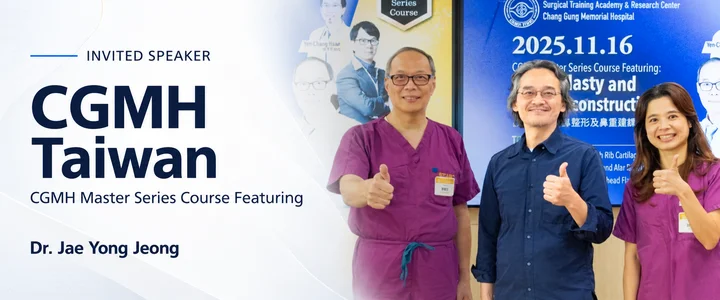
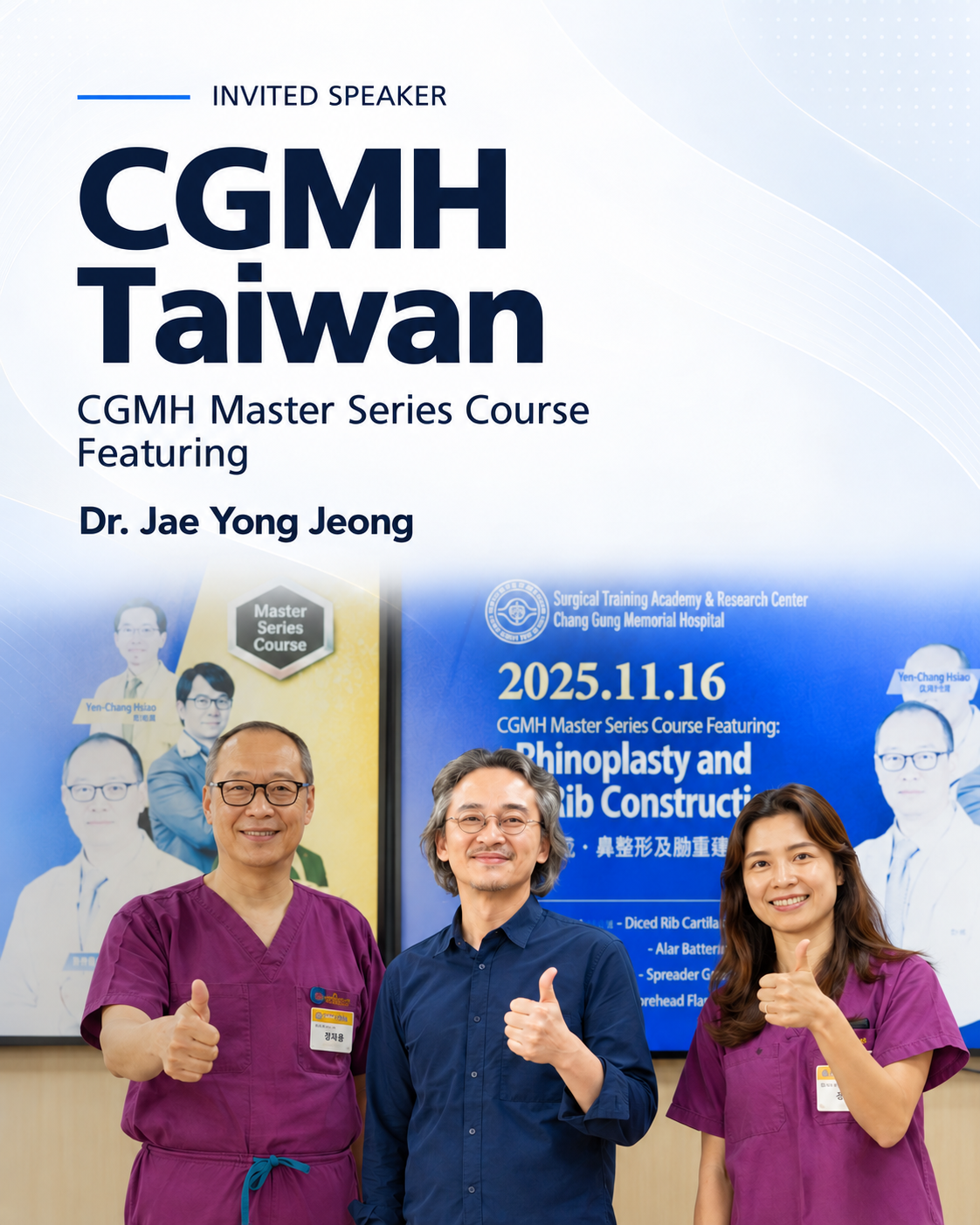
Dr. Jae Yong Jeong of THE PLUS Plastic Surgery was invited as the principal demonstration instructor for the CGMH Master Series Course Featuring: Rhinoplasty and Nasal Reconstruction, held on November 16, 2025, at the Surgical Training and Research Center of Chang Gung Memorial Hospital in Taiwan.
The program was a specialist training course for plastic surgeons and trainees with an interest in rhinoplasty and nasal reconstruction.
Through lectures and anatomical demonstrations, Dr. Jeong explained nasal anatomy and a range of surgical approaches to the participating clinicians.
What does a principal demonstration instructor do?
The title “Main Model Teacher,” used in the official program, refers to the main or principal demonstration instructor.
The role goes beyond theoretical lectures: the instructor directly demonstrates surgical steps and tissue-handling techniques using actual anatomical structures and guides participants through practical training.
By explaining each step, including where and how to dissect and how to identify and position cartilage, the instructor provides highly specialized training for medical professionals.
Training in open rhinoplasty and the use of rib cartilage
The course covered a range of topics, including open and closed rhinoplasty, rhinoplasty using rib cartilage, nasal osteotomies, and correction of a deviated nose and nasal tip.
Open rhinoplasty involves an incision at the base of the columella, allowing the skin of the nasal tip to be lifted so that the underlying cartilage and support structures can be examined directly.
This wider view of nasal anatomy may be considered in complex rhinoplasty, revision surgery or cases requiring reconstruction of nasal support.
Rib cartilage is the patient’s own tissue and may be used when ear or septal cartilage alone cannot provide sufficient support. It is not necessary for every patient, however. Its use should be decided after assessing the amount of cartilage required, the current condition of the nose and any history of previous surgery.
Why anatomical research matters in surgery
Although the nose is small, it contains closely interconnected tissues, including bone, cartilage, ligaments, muscles, blood vessels and mucosa.
Without a precise understanding of this anatomy, it is difficult to fully account for nasal tip support, left-right balance and the internal structures involved in breathing.
Cadaver dissection training is a specialist educational process that allows clinicians to examine human anatomy directly and repeatedly study surgical approaches.
THE PLUS Plastic Surgery will continue academic exchanges and anatomical research with medical institutions in Korea and abroad, working toward care that considers nasal appearance, structure and function together.